Modelo 390: Spain's yearly VAT summary return, explained
Modelo 390 sums up a whole year of VAT on one form: the VAT you charged, the VAT you paid on costs, and what your quarterly Modelo 303 returns came to. You pay nothing with it. The return for 2026 is filed between 1 January and 1 February 2027.
- Deadline: Monday 1 February 2027, because 30 January falls on a Saturday.
- Nothing to pay: it is an information return; the VAT went in with each 303.
- Exempt: SII filers, and quarterly filers taxed only in the common territory who only let urban property and/or use the módulos regime.
- Online only: with a digital certificate or, for individuals, Cl@ve.
Facts checked on 12 November 2026 against the BOE and the Agencia Tributaria.
What Modelo 390 is, and what it is for
Modelo 390 is Spain's yearly VAT summary return (declaración-resumen anual del IVA). It gathers in one document everything you already declared during the year in your quarterly or monthly Modelo 303 returns. There is nothing to pay or reclaim with it; it is filed online with the Agencia Tributaria in the January after the year.
What Modelo 390 sums up
Spain's VAT Act requires everyone who files periodic VAT returns to file "a yearly summary return" as well (art. 164.Uno.6.º). The VAT Regulation sets it out in article 71.7, and Orden EHA/3111/2009 approves the form, Modelo 390, and says who files it and when.
Over the whole year, it adds up the VAT you charged at each rate, the VAT you can deduct, the results of the year's returns (what was payable, credits still to carry forward and the last return's result), your total turnover, your business activities and, where it applies, your pro-rata percentage.
Modelo 303 and Modelo 390: how they fit
Modelo 303 is the VAT return of each quarter (or month): it is how you pay VAT, carry a credit forward or claim a refund. Modelo 390 settles nothing: it summarises what those 303s already said, and its totals must match them. If a 303 was wrong, you correct that 303 first.
| Modelo 303 | Modelo 390 | |
|---|---|---|
| What it is | The VAT return of one period | The yearly VAT summary |
| How often | Every quarter (or month) | Once a year |
| Do you pay with it? | Yes, if VAT is due | No: it only summarises |
| Deadlines for 2026 | Q1–Q3: 1–20 April, July and October. Q4: by 1 February 2027 | 1 January to 1 February 2027 |
| How it is filed | Online | Online only |
Do you pay anything with Modelo 390?
No. The year's VAT is paid (or carried forward, or reclaimed) with each Modelo 303. Orden HAP/2194/2013 treats the 390 as an information return: it carries information, not a debt, which is also why there is no direct debit for it.
The Basque Country, Navarre, the Canary Islands, Ceuta and Melilla
This page covers the Agencia Tributaria's Modelo 390, the one for the so-called common territory (territorio común). If you pay VAT only to the Basque or Navarrese tax authorities (the haciendas forales), you file what they require. If you pay to both the State and a foral authority, you declare all your transactions on the 390 and give each administration's percentage in its section 8; the results in section 9 are the common territory's (Modelo 390 instructions).
The Canary Islands, Ceuta and Melilla are outside Spanish VAT altogether (VAT Act, art. 3.Dos) and have their own indirect taxes: someone who trades only there files neither the 303 nor the 390. Sales from the mainland or the Balearics to those territories do go on them, as exports or out-of-scope supplies.
Official sources: Orden EHA/3111/2009 · VAT Regulation, art. 71.7 · VAT Act, art. 164.Uno.6.º · Orden HAP/2194/2013, art. 1.3
Who must file Modelo 390, and who is exempt
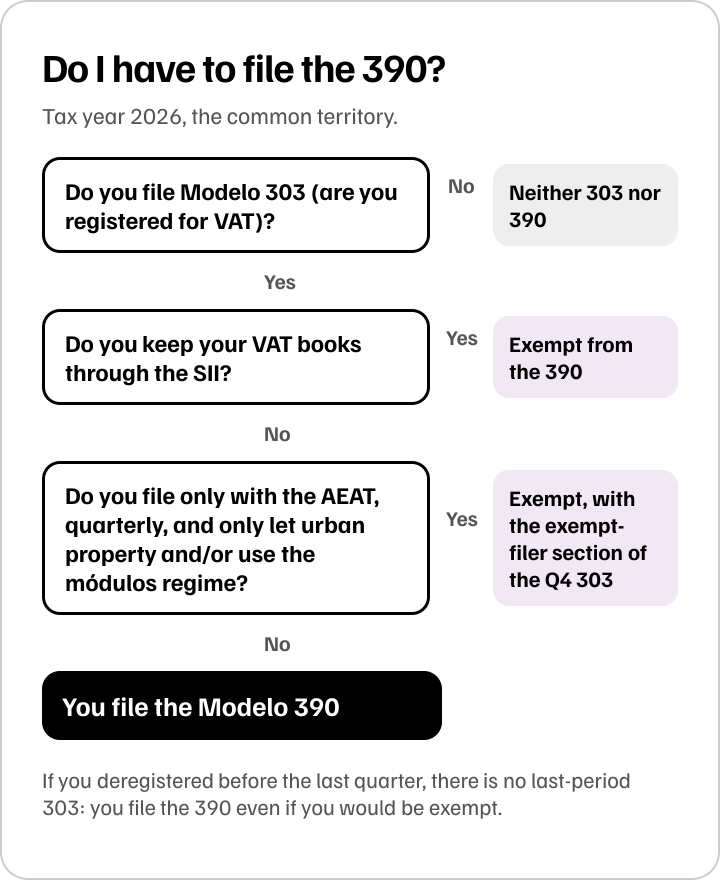
Every business or self-employed person who must file Modelo 303 also files the 390, even after a year with no transactions. Exempt are those who keep their VAT books through the SII, and quarterly filers taxed only in the common territory whose sole activities are letting urban property and/or the simplified (módulos) regime.
Who has to file
The rule is simple: if you must file Modelo 303, you also file the 390 (Orden EHA/3111/2009, art. 1.2), even with no transactions in the year: the VAT Regulation requires the returns "even where no VAT has been charged or deducted" (art. 71.1).
- Self-employed people (autónomos) and professionals under the general VAT regime.
- Companies and other entities, including co-ownerships (comunidades de bienes) with taxable transactions.
- Anyone with several activities, one of which is neither letting urban property nor under módulos and has its own periodic returns.
- Non-residents who file Modelo 303 for an activity other than letting urban property (if they only let urban property, file quarterly and are taxed in the common territory, they are exempt like any landlord). What else a Spanish home has to declare: CasitaTax's obligations check.
Who does not have to file Modelo 390
Orden EHA/3111/2009 (art. 1.3) exempts two groups, and the VAT Regulation a third:
- Taxpayers who keep their VAT books through the SII (Suministro Inmediato de Información, the Agencia Tributaria's real-time VAT reporting).
- Quarterly filers taxed only in the common territory whose sole activities are under the simplified VAT regime (módulos) and/or letting urban property. Other activities that need no periodic returns don't break the exemption.
- Those who make only VAT-exempt supplies (VAT Act, arts. 20 and 26), who file no 303 either (VAT Regulation, art. 71.1 and 71.7).
The last 303's section for exempt filers
The exemption has a price: whoever skips the 390 must fill in, in the 303 for the last period of the year, the section reserved for exempt filers, with the type of activities, the pro-rata if any, separate business sectors, the split between tax administrations and the year's total turnover (Orden EHA/3111/2009, art. 1.4).
That is why the exemption doesn't apply when there is no last-period 303: if you deregistered before the fourth quarter, the year is summed up on Modelo 390 (art. 1.3, last paragraph).
Lettings: premises, homes and holiday lets
- Commercial premises or an office let out, as your only activity, filing the 303 quarterly in the common territory: no 390; in the Q4 303 you tick that you are exempt and fill in its section (the Agencia Tributaria's FAQ on VAT and lettings).
- A home let without VAT (no hotel services and, if furnished, for more than 30 nights to the same tenant, or in your own main home): the rent is VAT-exempt, so there is no 303 and no 390 (VAT Regulation, art. 71.1 and 71.7; INFORMA 138945).
- Premises let out plus another activity with its own 303 (professional services, say, or a shop that is neither under the equivalence surcharge nor under módulos): the exemption is gone, you file the 390.
- A holiday let of 30 nights or fewer to the same tenant (unless in your main home), or with hotel services, from 1 December 2026: the let is subject to VAT, but whether the 390 is due is not settled yet (see the holiday-let section).
Módulos, the equivalence surcharge and other cases
- Módulos (the simplified VAT regime), as your only activity, filing quarterly in the common territory: exempt, with the section of the Q4 303.
- The equivalence surcharge (recargo de equivalencia) or the special farming regime: activities with no periodic returns, so they don't break the exemption of someone who only lets property or uses módulos (INFORMA 141198).
- Large companies, REDEME refund-register members and VAT groups file monthly and use the SII, so they file no 390; their exempt-filer section goes in their December return (the 303, or Modelo 322 for VAT groups). Voluntary SII filers are exempt too.
- Occasional Modelo 309 filers do not file the 390 (INFORMA 108185).
Starting or stopping during the year, and years with no activity
If you start during the year, the 390 covers the periods you were registered for. If you deregister before the last quarter, there is no last-period 303, so you file the 390 even if you would otherwise be exempt (Orden EHA/3111/2009, art. 1.3; the Agencia Tributaria's FAQ).
If you are still registered and had no transactions, you still file each 303 (ticking "Sin actividad" when no VAT was charged or paid) and the 390, unless you are exempt (VAT Regulation, art. 71.1).
Do you have to file the 390?
CasitaTax, our partner, files it in your name, matched with the year's 303s.
Official sources: Orden EHA/3111/2009, art. 1 · VAT Regulation, art. 71.1 and 71.7 · Modelo 390 instructions (AEAT) · INFORMA 141198 · AEAT: VAT on lettings
Modelo 390 deadline: 1 February 2027
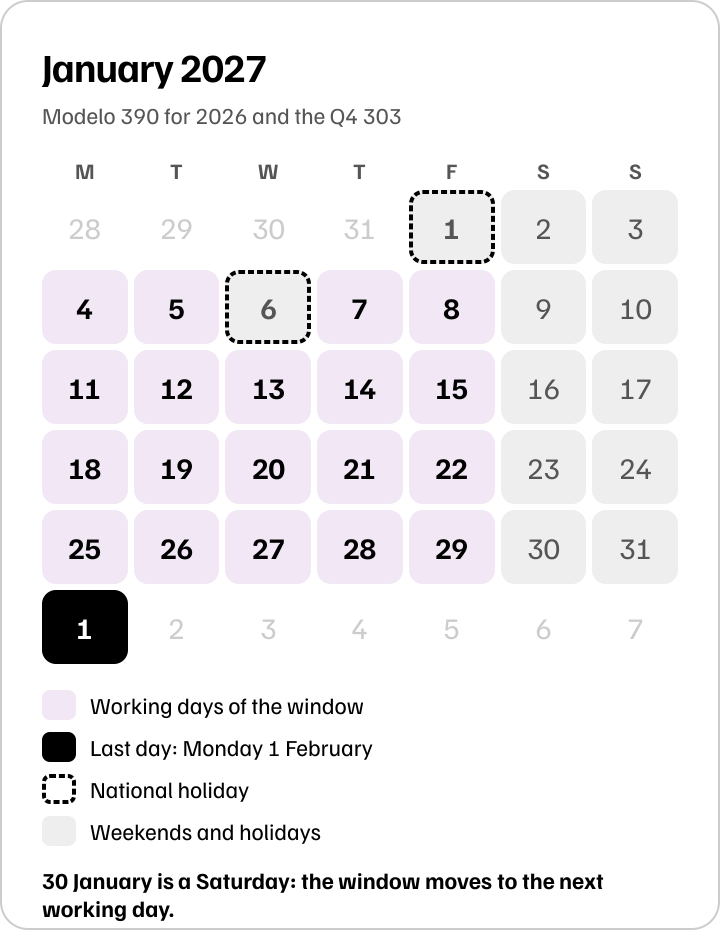
Modelo 390 is filed in the first thirty calendar days of January after the tax year. For 2026, the window runs from 1 January to Monday 1 February 2027: 30 January falls on a Saturday, and a deadline ending on a non-working day moves to the next working day.
| Return | Deadline | Rule |
|---|---|---|
| Modelo 390, tax year 2026 | 1 January to 1 February 2027 | Orden EHA/3111/2009, art. 8 |
| Modelo 303, Q4 2026 | 1 January to 1 February 2027 | VAT Regulation, art. 71.4 |
| Modelo 303, Q4, paid by direct debit | By 27 January 2027 (our calculation) | Orden EHA/1658/2009, art. 3.2.b and annex II |
| Modelo 349, last period of 2026 | By 1 February 2027 | VAT Regulation, art. 81.3 |
| Modelo 303, Q1 2027 | 1 to 20 April 2027 | VAT Regulation, art. 71.4 |
| Modelo 303, Q2 2027 | 1 to 20 July 2027 | VAT Regulation, art. 71.4 |
| Modelo 303, Q3 2027 | 1 to 20 October 2027 | VAT Regulation, art. 71.4 |
When the last day falls on a weekend or a holiday
The 390's rule says "the first thirty calendar days of January" (Orden EHA/3111/2009, art. 8). In 2027, 30 January is a Saturday. Saturdays, Sundays and public holidays are non-working days, and "when the last day of a period is a non-working day, the period is extended to the next working day" (Ley 39/2015, art. 30.2 and 30.5, which apply to tax procedures where tax law is silent). The Agencia Tributaria's instructions say the same: deadlines that fall on a non-working day move to the next working day.
1 February 2027 is neither a national nor a regional holiday (BOE list of 2027 public holidays). Last day: Monday 1 February 2027, unless it is a local holiday where you are, which moves it to the next working day. It happened in 2021 too, when 30 January was also a Saturday: the Agencia Tributaria's calendar gave the Q4 303 and the 390 "until 1 February". The 2027 calendar is not out yet (checked 12 November 2026).
Paying the Q4 303 by direct debit: earlier
The 390 has nothing to pay, so no direct debit. The Q4 303 does: direct debit normally runs from 1 to 25 January, and moves by as many days as the filing deadline does (Orden EHA/1658/2009, art. 3.2.b). By our calculation, in 2027 it runs to 27 January 2027; the Agencia Tributaria hasn't published its 2027 calendar yet (checked 12 November 2026).
If the online office fails on the last day
When technical problems make online filing impossible within the deadline, an information return such as the 390 (or the 349) can be filed in the following 4 calendar days (Orden HAP/2194/2013, art. 17.2). It is a safety net for technical failures, not a general extension, and it does not cover the 303.
Large businesses and the SII
Businesses that settle VAT monthly (for instance with turnover above €6,010,121.04 the year before) file a 303 every month; if they keep their books through the SII, they file no 390.
The deadline is 1 February
Send us your details in good time and CasitaTax files your 390 and your Q4 303 in your name.
Official sources: Orden EHA/3111/2009, art. 8 · VAT Regulation, art. 71.4 · Ley 39/2015, art. 30 · Public holidays 2027 (BOE) · Orden EHA/1658/2009
Modelo 390 boxes: what goes where
Modelo 390 has thirteen sections. The boxes that matter most are the year's VAT charged by rate (boxes 01 to 06; total in box 47), the VAT deductible (total in box 64), the general-regime result (65), the results of your 303s (95, 97 and 98), your turnover (108) and, where it applies, the pro-rata.
| Box | What it holds | Where it comes from |
|---|---|---|
| 01 and 02 | Taxable base and VAT at 4% | The total of your 303s at 4% |
| 03 and 04 | Taxable base and VAT at 10% (the holiday-let rate from 1 December 2026) | The total at 10% |
| 05 and 06 | Taxable base and VAT at 21% | The total at 21% |
| 21 to 26 | Goods bought from other EU countries, by rate | Your intra-EU purchases of goods |
| 27 and 28 | VAT due under the reverse charge | Supplies where you account for the supplier's VAT |
| 33 and 34 | Total taxable bases and VAT | All the VAT charged |
| 47 | Total VAT and equivalence surcharge | All the year's VAT charged |
| 48 and 49 | Deductible VAT on domestic current purchases | Your business expense invoices |
| 50 and 51 | Deductible VAT on capital goods | Purchases of capital goods |
| 64 | Total deductions | All the year's deductible VAT |
| 65 | General-regime result | VAT charged minus VAT deductible |
| 84 to 86 | Sum of results, credits brought forward and result of the year | 86 = 84 + 659 − 85 − 112 (2026 design) |
| 95 | Total payable on the year's 303s | Everything your 303s showed as payable, even if deferred or unpaid |
| 97 and 98 | Result of the last 303: credit carried forward or refund | Your Q4 (or December) 303 |
| 99 | General-regime transactions | Your sales and services for the year, before VAT |
| 105 | Exempt transactions without the right to deduct | For instance, a VAT-exempt home let alongside another activity |
| 108 | Total turnover | The turnover boxes added up, minus boxes 106 and 107 |
| 114 to 118 | Pro-rata: activity code, amounts, type and percentage | Only with both deductible and non-deductible transactions |
| 112 | New for 2026: payment on account deducted for petrol, diesel and biofuel supplies | Orden HAC/27/2026; it concerns few filers |
The form's thirteen sections
The Agencia Tributaria's instructions divide Modelo 390 into thirteen sections; most self-employed people only fill in a few:
- 1 to 4: the taxpayer, the tax year (and whether it replaces an earlier return), statistical data and the representative.
- 5: general-regime transactions: VAT charged and VAT deductible.
- 6 and 7: the simplified regime and the result of the year.
- 8: the split between tax administrations (if you also pay to the Basque Country or Navarre).
- 9 and 10: the results of the year's returns and turnover.
- 11 to 13: specific transactions, pro-rata and activities with separate deduction regimes.
How the 390 ties in with your 303s
The VAT charged and deductible on the 390 are the totals of your 303s for the year. The boxes that tie straight to them are 95 (everything your 303s showed as payable, even if you deferred or didn't pay it), 97 or 98 (the result of the last 303, carried forward or refunded), 85 (credits from earlier years you used in box 78 of a 303) and 662 (credits from other periods of the year that you didn't use).
If you corrected a period with a corrective self-assessment (autoliquidación rectificativa), use its figures instead of the original 303's: it carries all the period's data (VAT Regulation, art. 74 bis.3). Only the old supplementary returns, from before Q3 2024, are added to their period. If the totals don't match, there is almost always a 303 to correct before the 390.
Statistical data: activity key and IAE heading
Section 3 gives each activity a key (for instance A01 lessors of property, A03 other business activities, A05 other professional activities) and its heading in the business tax register (IAE), and asks whether you must file Modelo 347. Spain's tax rulings office (DGT) puts holiday lets in IAE group 685, "non-hotel tourist accommodation", whether or not services are provided (rulings V1494-26 and V1551-24); which 390 key goes with that group, no text says yet.
What goes in the last 303's exempt-filer section
Whoever doesn't file the 390 gives the same picture in a section of the last-period 303: the same keys and headings, the split between administrations and the year's turnover, broken down in boxes such as [80] (general-regime transactions) and totalled in box [88], plus the pro-rata if any. In that period the 303 asks whether you are exempt from the 390 and whether your yearly turnover is above zero.
The Agencia Tributaria's tools
The 390's page on the online office has a simulator (Simulador 390, OPEN) that needs no identification and files nothing, but can export a file to file later through the "with a file" route (not for SA and SL companies). The Agencia Tributaria also offers a helper for the "basic Modelo 390", limited to quarterly filers under the general regime with no pro-rata and no foreign trade.
Worked example: four 303s into one 390
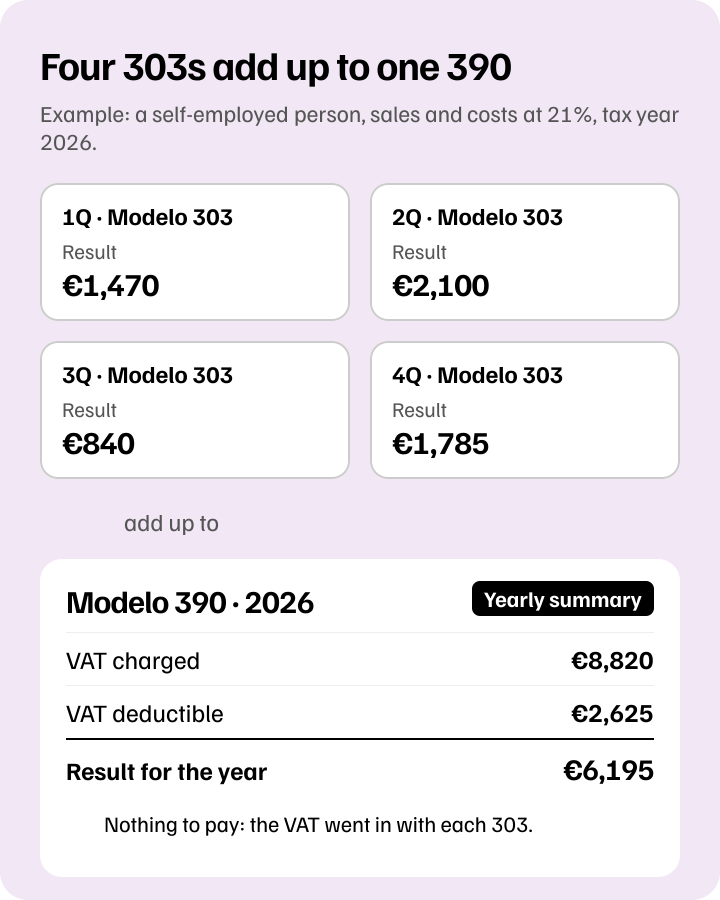
A self-employed designer charges 21% VAT on everything, and their costs carry 21% too. Their four 303s for 2026, all with VAT to pay, are in the table.
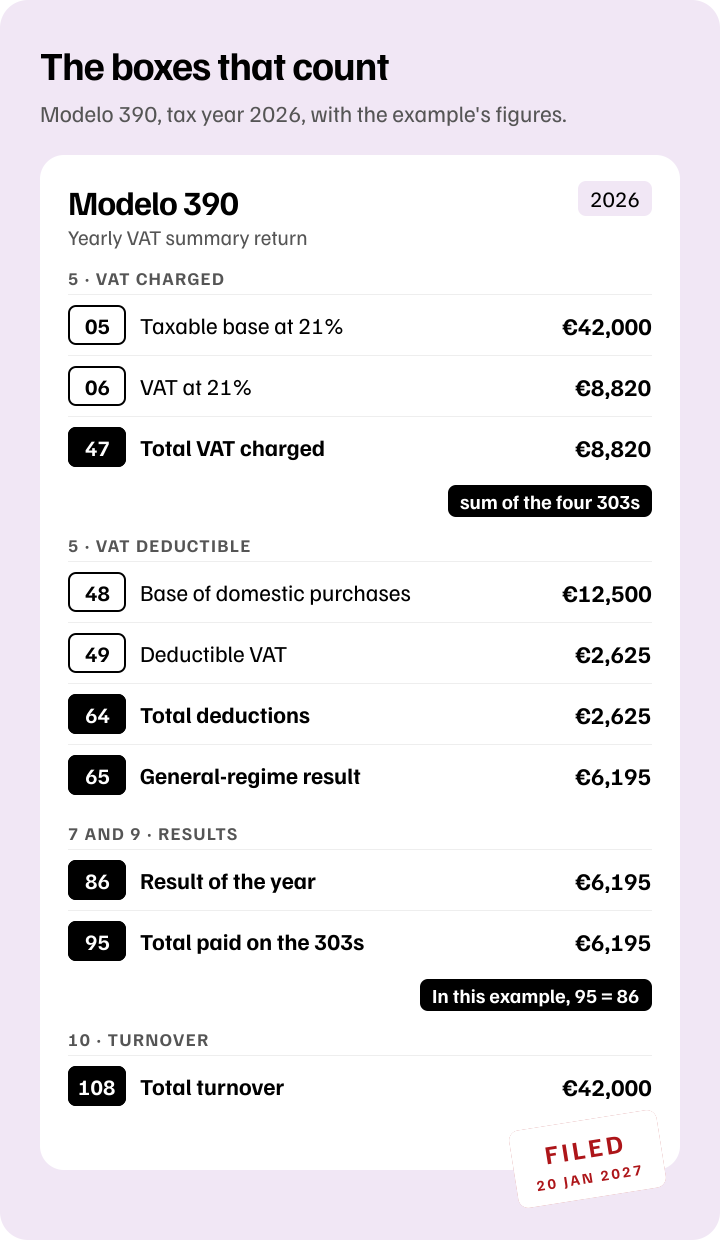
On their 390, boxes 05 and 06 carry €42,000 of taxable base and €8,820 of VAT; boxes 48 and 49, €12,500 and €2,625. The general-regime result (65) and the year's result (86) are €6,195, the same as box 95, the total paid with the four 303s. Turnover (99 and 108) is €42,000. Everything matches, and there is nothing to pay.
| Quarter | VAT charged | VAT deductible | Result |
|---|---|---|---|
| Q1 | €2,100 | €630 | €1,470 |
| Q2 | €2,520 | €420 | €2,100 |
| Q3 | €1,890 | €1,050 | €840 |
| Q4 | €2,310 | €525 | €1,785 |
| Year (390) | €8,820 | €2,625 | €6,195 |
Rather not fill in the boxes?
CasitaTax checks that the 390 matches your 303s and files it for you.
Official sources: Modelo 390 instructions, tax year 2025 (AEAT) · Modelo 390 record design, tax year 2026 (AEAT) · Orden HAC/27/2026 · Modelo 303 instructions 2026 (AEAT)
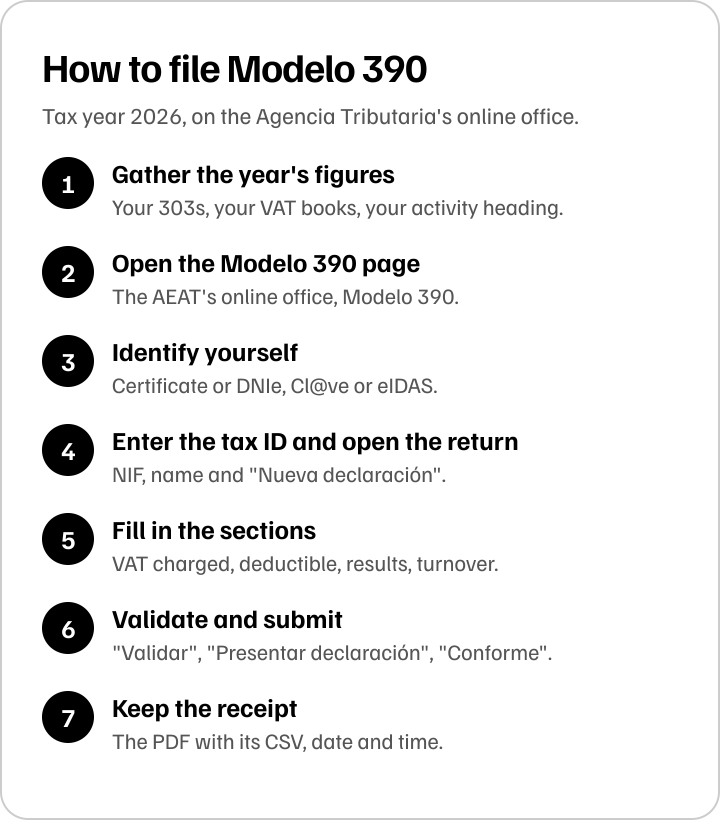
How to file Modelo 390 step by step
Modelo 390 is filed online only, on the Agencia Tributaria's online office (Sede electrónica): with a digital certificate, with Cl@ve if you are an individual not required to use a certificate, or with eIDAS. You fill in the form, validate it, submit it and keep the PDF with its secure verification code. A representative can file it for you.
Filing Modelo 390 on the Sede electrónica
- 1
Gather the year's figures
Have your 303s for the year to hand (with any corrective ones), your books of invoices issued and received, the IAE heading of each activity and, if it applies, your pro-rata.
- 2
Open the Modelo 390 page
On the Agencia Tributaria's online office, open the Modelo 390 page and pick the filing option for the year you are declaring (the 2026 one appears for the January 2027 window).
- 3
Identify yourself
With a digital certificate or an electronic ID card (DNIe); if you are an individual, also with Cl@ve or, as an EU citizen with a Spanish DNI, NIE or NIF, with eIDAS. Companies and other entities, co-ownerships included, file with a digital certificate (or through a representative).
- 4
Enter the tax ID and open the return
Enter the filer's tax ID (NIF) and name, then click "Aceptar": the NIF can't be changed afterwards. Choose "Nueva declaración" (new return), or "Continuar" to pick up one you saved.
- 5
Fill in the sections
Fill in the sections that apply to you: statistical data, VAT charged and deductible, the results of the year's returns, turnover and, if it applies, the pro-rata. The totals come from your 303s. You can click "Guardar" (save) and come back later.
- 6
Validate and submit
Click "Validar": warnings don't stop you filing, errors must be fixed. Then click "Presentar declaración", tick "Conforme" and click "Presentar declaración" again.
- 7
Keep the receipt
The online office shows the accepted return with its secure verification code (CSV), the date and time of filing, and the PDF. Keep it with your 303s: if you ever have to replace the return, you will need its 13-digit receipt number.
With a file, in batches, or through someone else
If your accounting software produces the 390 file, the "Presentación (con fichero)" option reads it ("Leer declaración") and files it with "Firmar y Enviar"; its fields can no longer be edited. Tax advisers also have a batch-filing option.
A representative can file it for you: someone you have authorised (apoderamiento), or a professional authorised to file returns on others' behalf (colaborador social) (General Tax Regulation, arts. 79 to 81; Orden HAP/2194/2013, art. 16).
Can you file on paper? What about the Modelo 390 PDF?
No: the 390 is filed online only (Orden HAP/2194/2013, art. 12). Paper ended in 2014 and SMS in 2020; in 2023 the articles of the form's order that still mentioned them were struck out. The PDFs the Agencia Tributaria publishes are its instructions; the PDF that matters is the one of your filed return, which the online office gives you when you file.
How to download a Modelo 390 you have filed
On the Modelo 390 page of the online office, the option "Modelo 390. Consulta de declaraciones presentadas" lists the returns you have filed, once you identify yourself as when filing.
- Checks the 390 matches your 303s
- Files it in your name
- Sends you the receipt
Official sources: Modelo 390 on the Sede electrónica · Technical help: filing with the web form (AEAT) · Orden HAP/2194/2013, arts. 12, 13 and 16 · AEAT VAT manual 2026
Mistakes, corrections and penalties for Modelo 390
A Modelo 390 with mistakes is corrected with a replacement return (declaración sustitutiva). Filing it late, or not at all, is a minor offence under article 198 of Spain's General Tax Act: the fine is halved if you file before the tax office asks you to, and cut by a further 40% if you pay it on time without appealing.
How to correct a Modelo 390 you have filed
With a replacement return (declaración sustitutiva): a complete new 390 on which you tick the "Declaración sustitutiva" box and give the 13-digit receipt number of the return it replaces (the Agencia Tributaria's Modelo 390 instructions). For the 390, the instructions only provide the replacement route.
If the mistake is in a 303, correct that 303 first. Since Q3 2024 (September 2024 for monthly filers), a filed 303 is corrected with a corrective self-assessment (autoliquidación rectificativa; VAT Regulation, art. 74 bis; Orden HAC/819/2024). Then, if the 390 was already filed, replace it so that it matches again.
The penalty for a late or missing 390
The 390 has nothing to pay, so filing it late causes the tax office no financial loss: it is the minor offence of article 198 of the General Tax Act. What no official text says is which paragraph of that article applies to the 390:
| Reading | Fine | Filed late before the tax office asks |
|---|---|---|
| An ordinary return (art. 198.1, third paragraph) | €200 flat | €100 |
| An information return under arts. 93 and 94 (art. 198.1, fourth paragraph) | €20 per item, from €300 to €20,000 | Half: from €150 |
What reduces the fine
Filing before the tax office asks you to halves the fine (art. 198.2). And any fine is cut by 40% if you pay it within the voluntary period and don't appeal (art. 188.3, in force since 11 July 2021; the old 25% no longer applies to penalties). As we read it, under the second reading the fine would be the minimum, €300 (€150 before any request), since a 390 only holds data about the filer. Under either reading, filing as soon as possible is the cheapest option.
Filing an incomplete or inaccurate 390, with no financial loss to the tax office, is another offence, a serious one (art. 199): a flat €150 if the 390 counts as an ordinary return (art. 199.2); as an information return under arts. 93 and 94, sections 199.4 and 199.5 would apply. But if a late replacement 390, filed before any request, corrects one filed on time, only the article 198 penalty for what was filed late applies (art. 198.2).
As of 12 November 2026 we have found no ruling of the central tax tribunal (TEAC) and no Agencia Tributaria text saying which paragraph of article 198.1 applies to Modelo 390.
A late 303: surcharges
A 303 with VAT to pay, filed late before any request, carries no fine but a surcharge: 1% plus 1% for each full month of delay; after 12 months, 15% plus late-payment interest (art. 27.2). The surcharge is cut by 25% if paid within the legal deadlines (art. 27.5). A late 303 with nothing to pay follows article 198: €200, or €100 before any request.
Missed the deadline, or got a letter from the tax office?
Tell us about it in the form and CasitaTax gets back to you.
Official sources: General Tax Act (LGT), arts. 27, 188, 198 and 199 · VAT Regulation, art. 74 bis · Modelo 390 instructions (AEAT)
Holiday lets and VAT: the first 303 and Modelo 390
From 1 December 2026, 10% VAT applies to lets of furnished homes with hotel services or of 30 nights or fewer to the same tenant, unless, in that case, it is your main home. Owners must register (Modelo 036) and file a Q4 303 by 1 February 2027. Whether the 390 is also due is not settled yet.
What changes on 1 December 2026
Real Decreto-ley 29/2026 (BOE of 7 October 2026), ratified by the Congreso's Standing Committee (Diputación Permanente) on 12 November 2026, takes out of the VAT exemption, from 1 December 2026, lets of furnished flats and homes where the landlord provides hotel-type services (as before) or where the let to the same tenant lasts no more than 30 nights, "except where it takes place in the flat or home in which the landlord has their main residence". They are taxed at the reduced rate of 10% (VAT Act, arts. 20.Uno.23.º e' and 91.Uno.2.2.º).
Every landlord is a business for VAT purposes (art. 5.Uno.c): one home let this way means registering with Modelo 036, invoicing, and filing a 303 every quarter, even when there is nothing to declare (VAT Regulation, art. 71.1). The decree sets no minimum turnover and no transitional rule. CasitaTax's guide to VAT on short-term lets explains which lets pay it and which stay exempt.
The first 303 and the first 390: tax year 2026
For an owner who starts charging VAT in December 2026, the first 303 is the one for Q4 2026, with a single month of lets, due by 1 February 2027. It is how December's VAT is paid.
And the 390? It turns on a question no text has answered yet: whether these lets count as "letting of urban property" for the exemption in Orden EHA/3111/2009 (art. 1.3.a). The VAT Act calls them "lets of furnished flats or homes", and taxes them at 10% alongside hotel services.
- If they count as letting urban property: a quarterly filer taxed only in the common territory, with no other activity that files a 303, is exempt from the 390 and fills in the exempt-filer section of the Q4 303. For this reading: the Agencia Tributaria already applies the exemption to other homes let with VAT (INFORMA 138944 and 138946), and the law still calls them lets.
- If they don't: file the year's Modelo 390, in the same window as the Q4 303. For this reading: the DGT places holiday lets in IAE group 685, "non-hotel tourist accommodation", rather than with home rentals, whether or not services are provided (V1494-26), and in a 2024 ruling on tourist flats it said the yearly summary is due (V1551-24), without discussing the exemption.
What the Agencia Tributaria hasn't said yet
As of 12 November 2026, neither the BOE, the Agencia Tributaria nor the DGT has said which reading applies to the 390 for these lets, and no order adapting Modelos 303 and 390 to Real Decreto-ley 29/2026 has been published. Some of the Agencia Tributaria's FAQ pages on lettings, dated October 2026, still say tourist flats without hotel services are VAT-exempt: that is the rule before 1 December 2026. Nor does the decree say what happens to bookings paid before that date for later stays. We will update this page as soon as there is an answer.
Non-residents, co-owners, the Canary Islands
- Owners established outside the EU: must appoint a representative domiciled in Spain before the first taxable let (VAT Act, art. 164.Uno.7.º; VAT Regulation, art. 82), unless they are established in a State with mutual-assistance arrangements like the EU's: according to the Agencia Tributaria, currently only Norway. Owners established in the United Kingdom or Switzerland do need one; owners established in the EU don't.
- VAT doesn't replace Modelo 210: a non-resident owner still declares the rental income on the non-resident income tax return (CasitaTax files Modelo 210). To count each stay's nights and the expenses, CasitaTax's free rental log keeps it all on your device.
- Several owners letting together: if they share the risk of the letting, the co-ownership (comunidad de bienes) meets the VAT obligations, with its own tax ID (VAT Act, art. 84.Tres; the Agencia Tributaria's FAQ); a co-owner who lets alone does so in their own name. Entities without legal personality file the 303 with a digital certificate.
- The Canary Islands, Ceuta and Melilla are outside VAT (VAT Act, art. 3.Dos): no 303 or 390 for lets there.
VAT on your holiday let, without the paperwork
CasitaTax registers your home (036), files each 303 and the yearly summary, and pays the VAT due in your name.
Official sources: Real Decreto-ley 29/2026, art. 7 · VAT Act, arts. 20, 84, 91 and 164 · Agencia Tributaria: RDL 29/2026 · Congreso: ratification · Orden EHA/3111/2009, art. 1.3 · DGT V1551-24 · DGT V1494-26 · INFORMA 138944 · AEAT: non-established businesses
What people ask about Modelo 390
The questions people search most, with short answers. If yours isn't here, write to contacto@modelo-390.com.
What is Modelo 390 and what is it for?
It is Spain's yearly VAT summary return: one document that sums up the VAT charged and deductible, the results and the turnover of a whole year you already declared on your Modelo 303 returns. It is an information return: you pay nothing with it.
Who has to file Modelo 390?
Every business or self-employed person who must file Modelo 303, even with no transactions in the year, except the exempt: SII filers, and quarterly filers taxed only in the common territory whose sole activities are letting urban property and/or the simplified regime.
What is the deadline for the 2026 Modelo 390?
Monday 1 February 2027. The rule gives the first thirty calendar days of January, but 30 January 2027 is a Saturday, and a deadline ending on a non-working day moves to the next working day.
Do I pay anything with Modelo 390?
No. VAT is paid, carried forward or reclaimed with each Modelo 303. The 390 only sums up the year, although its boxes record what those 303s showed.
Do I have to file Modelo 390 if I had no activity?
Yes, if you are still registered for VAT and not exempt: the VAT Regulation requires the returns even when no VAT was charged or deducted (art. 71.1). You also file each 303, ticking "Sin actividad" (no activity) where it applies.
What is the difference between Modelo 303 and Modelo 390?
The 303 is the VAT return of each quarter or month, with which you pay or reclaim VAT. The 390 is the yearly summary of those 303s: it settles nothing, and its totals must match them.
If I let out premises or a flat, do I file Modelo 390?
If letting premises is your only activity, filed quarterly in the common territory, no: you fill in the exempt-filer section of the Q4 303. A home let without VAT (no hotel services and, if furnished, for more than 30 nights) needs neither a 303 nor a 390. For holiday lets that carry VAT from 1 December 2026, no official text has said yet whether the 390 is due.
What happens if I file Modelo 390 late, or not at all?
It is a minor offence under article 198 of the General Tax Act. Depending on the paragraph that applies, which no official text specifies, the fine is €200, or €20 per item with a €300 minimum; it is halved if you file before any request, and cut by a further 40% if you pay on time without appealing.
How do I correct a Modelo 390 I have filed?
By filing a replacement return: a complete 390 with the "Declaración sustitutiva" box ticked and the 13-digit receipt number of the earlier one. If the mistake is in a 303, correct that 303 first with a corrective self-assessment.
Can I file Modelo 390 without a digital certificate?
Yes, with Cl@ve, if you are an individual; EU citizens can use eIDAS with a Spanish DNI, NIE or NIF. Companies and other entities, co-ownerships included, need a digital certificate or a representative. Paper filing isn't possible.
How do I download a Modelo 390 I have filed?
On the Modelo 390 page of the online office, through "Modelo 390. Consulta de declaraciones presentadas", identifying yourself with a certificate, DNIe or Cl@ve. When you file, the online office also gives you the PDF with its secure verification code.
Do holiday-let owners have to file Modelo 390?
From 1 December 2026 they file a 303 every quarter. Whether they must also file the 390, or only the exempt-filer section of the Q4 303, depends on whether their lets count as "letting of urban property": as of 12 November 2026, no official text has settled it.
Glossary: the form's Spanish terms
- IVA devengado (VAT charged)
- The VAT you charge your customers on your invoices, which you owe the tax office.
- IVA soportado and IVA deducible (input VAT and deductible VAT)
- Input VAT (soportado) is the VAT on your purchases and expenses; the deductible part is what you can subtract from the VAT charged, generally the VAT on your business expenses.
- Autoliquidación (self-assessment)
- A return on which you work out the tax yourself and pay it, like Modelo 303.
- Declaración informativa (information return)
- A return that gives the tax office information without paying anything, like Modelo 390, 347 or 349.
- Volumen de operaciones (turnover)
- The total amount, before VAT, of the goods and services you supplied in the year.
- Prorrata (pro-rata)
- The share of VAT on costs you can deduct when you make both supplies that allow deduction and supplies that don't.
- Territorio común (common territory)
- The regions taxed by the Agencia Tributaria, as opposed to the Basque Country and Navarre, which have their own tax authorities.
- SII
- Suministro Inmediato de Información: keeping the VAT books on the Agencia Tributaria's online office in near real time. SII filers don't file the 390.
- Régimen simplificado (módulos)
- A special VAT regime where VAT is worked out from fixed indicators, such as staff or floor area, instead of invoice by invoice.
- Declaración sustitutiva (replacement return)
- A complete new return that cancels and replaces one already filed with mistakes.
- Autoliquidación rectificativa (corrective self-assessment)
- How a filed Modelo 303 is corrected since Q3 2024.
- Requerimiento (formal request)
- A letter from the tax office asking you to file or explain a return; filing before you receive one reduces the penalty.
Let CasitaTax do it
File my 390Would you like CasitaTax to file it?
Leave your details and CasitaTax, our partner, will contact you to file your 390 and 303s in your name.
CasitaTax files your VAT returns in your name (registration with the 036, each quarter's 303 and the yearly summary), pays the VAT due in your name, and runs a VAT plan for holiday lets.
See CasitaTax's holiday-let VAT serviceBasic information on data protection
- Controller:
- ONBOARDING, S.L.
- Purpose:
- passing your request to CasitaTax so that it contacts you about it.
- Legal basis:
- your consent (GDPR art. 6.1.a), which you can withdraw at any time.
- Recipients:
- CasitaTax (ZAHARD LTD, United Kingdom, a country with a European Commission adequacy decision); as processors, Cloudflare, n8n and Discord (Cloudflare and Discord in the United States, certified under the EU-U.S. Data Privacy Framework).
- Your rights:
- access, correction, erasure, objection, restriction and portability, at contacto@modelo-390.com; and a complaint to the Spanish data protection authority (AEPD).
- More information:
- in the privacy policy.